COORDINATE PLANE

COORDINATE PLANE

Gap-fill exercise

Fill in all the gaps, then press "Check" to check your answers. Use the "Hint" button to get a free letter if an answer is giving you trouble. You can also click on the "[?]" button to get a clue. Note that you will lose points if you ask for hints or clues!

COORDINATE PLANE

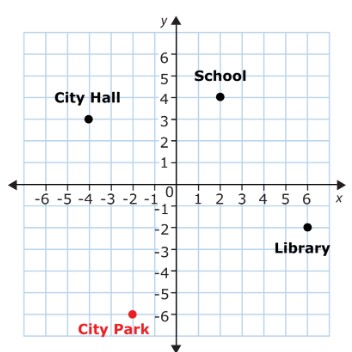
Look at the grid bellow:

COORDINATEPLANE .jpg

1. How do you get from the origin to the City Park?
A. Move right 2 units and up 4 units
B. Move left 2 units and down 6 units
C. Move left 5 units and up 3 units
D. Move right 6 units and down 2 units

The correct answer is letter


2. How do you get from the origin to the Library?
A. Move right 2 units and up 4 units
B. Move left 2 units and 6 down units
C. Move left 5 units and up 3 units
D. Move right 6 units and down 2 units

The correct answer is letter

3. How do you get from the origin to the School?
A. Move right 2 units and up 4 units
B. Move left 2 units and 6 down units
C. Move left 5 units and up 3 units
D. Move right 6 units and down 2 units

The correct answer is letter


4. How do you get from the origin to the City Hall?
A. Move right 2 units and up 4 units
B. Move left 2 units and 6 down units
C. Move left 4 units and up 3 units
D. Move right 6 units and down 2 units

The correct answer is letter


Look at the grid bellow:

COORDINATEPLANE .jpg

1. Write the position of the City Park?

2. Write the position of the School?

3. Write the position of the Library?

4. Write the position of the City Hall?


Translations, Rotations, Dilations and Reflections

Understanding the Transformations Visually

Seeing how these transformations work can make them much easier to remember.

1. Translations A translation simply moves a shape without changing its size, orientation, or shape. The entire figure shifts a certain number of units in a given direction.

2. Rotations A rotation turns a shape around a fixed point, known as the center of rotation. The figure maintains its size and shape, but its orientation changes.

3. Dilations A dilation changes the size of a shape by a scale factor. The figure becomes either larger (when the scale factor is greater than 1) or smaller (when it is less than 1), but its shape and orientation remain the same.

4. Reflections A reflection flips a shape over a line, called the line of reflection. The new figure is a mirror image of the original.